

Table of Contents
ToggleThe Death of the 5,000mAh Compromise
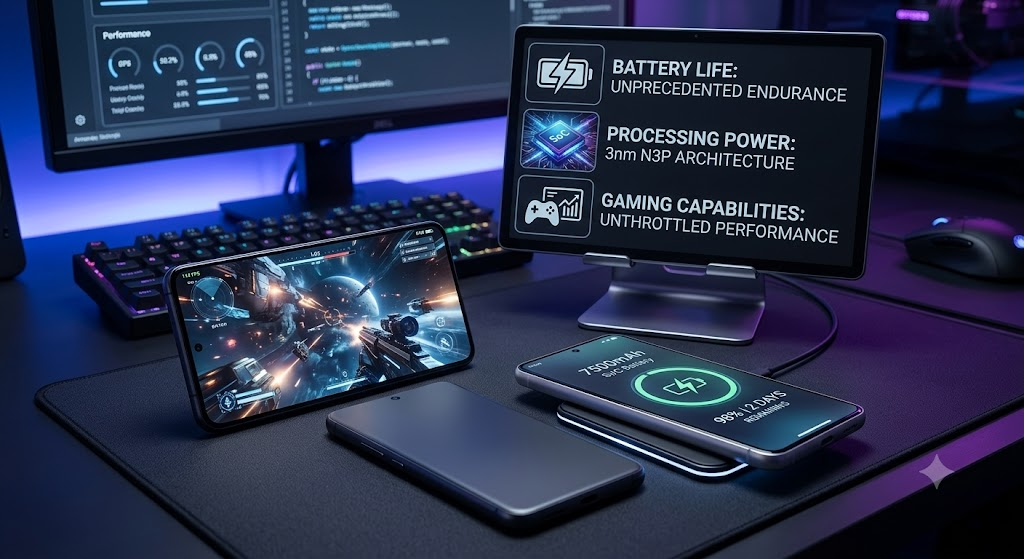
The days of settling for a 5,000mAh battery ceiling are officially dead. We finally have a completely different baseline in mobile hardware. Hardware teams are somehow fitting colossal 7,000mAh to 9,000mAh batteries inside chassis designs no thicker than 8.5mm. We owe this bizarre new reality almost entirely to TSMC; their foundries finally locked down the yields on that 3nm N3P process. This foundry tech allows silicon to easily clear 4.6 GHz without torching your motherboard.
The smartphone ecosystem hit a massive inflection point this year. Generational, boring tweaks are a thing of the past. Chassis physics used to trap us in a corner. The physical dimensions of a phone dictated exactly how much lithium-ion capacity a manufacturer could cram inside. Old passive cooling setups simply choked under pressure. That thermal wall meant your main processor dialed back its speed almost immediately during heavy loads to avoid a meltdown.
Silicon Warfare: Snapdragon Versus the Dimensity Logic Board
Look closely at the top-tier Android market and you will see an absolute bloodbath. Qualcomm rushed the Snapdragon 8 Elite Gen 5 out the door to protect their margins. MediaTek, refusing to back down, fired straight back with the Dimensity 9500. Both competing chips share one critical foundation. They utilize TSMC’s hyper-efficient 3nm N3P manufacturing node.
This specific foundry tech squeezes every last drop of efficiency out of the older FinFET architecture. The semiconductor supply chain desperately needed a reliable bridge before flipping over to incredibly expensive Gate-All-Around (GAA) nanosheets. N3P serves exactly that purpose.
Qualcomm completely abandoned standard ARM Cortex reference designs this cycle. Their engineering team utilized a proprietary third-generation Oryon layout instead. Two custom Oryon Prime cores sit inside, clocked at an insane 4.61 GHz alongside six 3.63 GHz Performance cores. Samsung even secured an exclusive variant for their Galaxy lineup. That specific chip overclocks the Prime cores to a blistering 4.74 GHz. You essentially walk out of the store with a flat 20 percent gain in raw CPU performance over last year’s hardware.
Run AnTuTu v10 for ten minutes. The final readout casually blows past the 4,000,000 barrier. Multi-core runs on Geekbench 6 print numbers above 11,400—and the back glass barely even gets warm.
MediaTek took a totally different route with their silicon logic. Their Dimensity 9500 relies on an “All-Big-Core” philosophy. You get a single ARM Cortex-C1-Ultra peaking at 4.21 GHz, backed by three 3.5 GHz C1-Premium cores—plus a quad-cluster of 2.7 GHz C1-Pro units to handle the rest. Qualcomm clearly wants to win the peak frequency battle. MediaTek built a thermal beast designed to handle brutal multithreaded workloads smoothly.
Memory Economics: The 85.3 Gbps Choke Point
A 4.6 GHz processor is utterly useless if the system starves it of data. Memory bandwidth is the actual choke point in modern mobile architecture. Flagship devices have fully transitioned to LPDDR5X Ultra RAM and UFS 4.1 storage to prevent this exact bottleneck.
Data flies across these modules at a staggering 8,533 Mbps. The broader motherboard architecture leverages an 85.3 Gbps maximum bandwidth pipeline through a 4×16-bit bus layout. Immense data pipes are absolutely mandatory for high-resolution video recording and complex 3D texture mapping. Otherwise, the phone stutters violently.
Supply chain analyses reveal a brutal financial reality for manufacturers right now. A standard 16GB RAM and 1TB storage bundle currently runs over $334 at wholesale. That specific memory package actually costs more than the primary Snapdragon chip itself. Hardware brands are slashing profit margins just to stay competitive on the shelf.
Thermodynamic Cheats: Vapor Chambers and Bolted-on Turbofans
Financial constraints aside, heat generation dictates actual sustained performance in the real world. These vacuum-sealed copper envelopes—known as vapor chambers—house a highly calibrated amount of deionized fluid.
Intense heat from the processor strikes the evaporator section. The trapped liquid immediately vaporizes upon contact. This rapid phase change yanks thermal load straight off the chip. The vapor pushes outward across the frame with conductivity levels hovering around 20,900 W/mK.
The OnePlus 15R serves as a masterclass in this specific thermal manipulation. Its engineering team slapped a massive 5,704mm² 3D vapor chamber inside the shell. This setup prevents thermal throttling and locks down frame rates during three-hour gaming marathons.
Passive spreading eventually hits a physical wall, though. Engineers in the gaming niche solve this by bolting on actual turbofans. This active aerodynamic approach forcibly exhales hot air through dedicated chassis vents. The result is a continuous, mechanical loop of cool air washing over the internal copper fins. Your silicon stays chilled even when pushed to its absolute breaking point.
Battery Alchemy: How Silicon-Carbon Killed the Wall Hugger
Let’s be real about the battery market. The aggressive pivot toward silicon-carbon chemistry is unarguably the most vital engineering jump we have seen in ten years. For thirty years, the industry relied on graphite anodes because they were chemically stable.
The catch? Graphite is highly restrictive. The material requires six carbon atoms just to trap one measly lithium ion.
Silicon atoms change the entire equation. That elemental swap elevates the theoretical specific capacity to roughly ten times higher than what old graphite could manage. Chemists managed to bind 5% to 15% nanoscale silicon inside a carbon matrix. This precise elemental swap pushes the gravimetric energy density to a massive 400 to 500 Wh/kg.
Retail shelves tell the real story here. People buy thin, 8.1mm phones every day without realizing a massive 7,400mAh cell sits inside a 215-gram body. Brands building specifically for road warriors, like the Xiaomi Redmi Note 17 Pro, push right past the 9,000mAh barrier. You get a legitimate two days of heavy use out of these, regardless of screen brightness or network strain.
The Browser Gaming Squeeze: WebGPU, AV1, and the Casino Shift
Modern smartphone usage extends far beyond native applications. Rich, browser-based environments place immense stress on the processing pipeline. Users actively abandon heavy app downloads in favor of browser portals.
Players hunting for no wagering casino bonuses frequently jump between dozens of interactive web environments daily. Live dealer casino games are historically brutal on mobile processors in these scenarios. The device must decode a 4K video feed instantly while simultaneously rendering a real-time 3D betting interface over the footage. A couple of years ago, that exact combination triggered catastrophic thermal throttling and immediate battery death.
Dedicated AV1 decoding blocks and the WebGPU API stepped in to permanently erase that specific performance choke point. Top foundries hardwired AV1 decoders directly into the physical layout of the Snapdragon 8 Elite Gen 5 and Dimensity 9500. The WebGPU interface then cuts the CPU completely out of the loop. Browsers push heavy 3D rendering instructions straight to the graphics module instead. Your daily driver effortlessly handles marathon browser gaming without overheating your hands.
Retail Reality: Trickle-Down Tech in the Indian Market
Advanced architecture trickles down to every price bracket in the Indian market today. Samsung owns the absolute high-end tier outright with the Galaxy S26 Ultra. That proprietary Snapdragon logic board drives the phone to a ridiculous 39,05,605 on AnTuTu. Thermals stay locked down because the chassis hides a massive 8,000 mm² single-layer vapor chamber right on top of the mainboard.
Anyone wanting maximum uptime for gaming marathons usually buys the OnePlus 15R. A colossal 7,400mAh silicon-carbon unit provides the juice for this particular rig. Mechanical airflow forces the OPPO K13 Turbo Pro to hold 107 fps in BGMI’s 120 fps tier. The phone registers a pathetic 7°C increase over ambient room temperature during heavy loads. This proves the tangible value of a physical turbofan.
The sub-Rs 25,000 tier demonstrates exactly how quickly this premium hardware becomes affordable. Realme recently shipped the P4x with a 7,000mAh battery alongside a highly capable processor. Infinix targets the exact same demographic with the GT 30. Their engineering team utilizes the MediaTek Dimensity 7400 to push consistent frame rates at a remarkably low Rs 21,999 price point.
The Supercomputer Reality
The era of mobile hardware compromise is officially dead. Buyers never have to choose between a thin profile and true multi-day battery endurance anymore. Mobile thermodynamics, raw silicon fabrication, and battery chemistry finally dance in perfect sync. We are no longer carrying simple communication devices. The reality is we are hauling around unthrottled, heavily weaponized pocket supercomputers, and the semiconductor supply chain is only going to push these boundaries further next year.