

Table of Contents
ToggleTwo Tools, One Purpose – Different Realities
Walk-through metal detectors and handheld security wands both detect metal. They both serve the same fundamental security purpose: ensuring that people entering a secured space are not carrying prohibited metallic items. Beyond that basic description, however, they are quite different tools suited to different operational realities. Choosing between them – or deciding when to use both – requires an honest assessment of what a facility actually needs to accomplish at its entry points.
The decision is rarely as simple as cost or convenience. A security wand in the hands of a well-trained operator can be more targeted than a portal detector. A walk-through system applied consistently to every entrant provides accountability that no selective wanding protocol can match. Understanding where each tool excels and where it falls short is the foundation of an intelligent screening decision.
PTI World manufactures both security wands and walk-through metal detector systems, giving facilities the flexibility to select the appropriate tool – or combination of tools – for their specific security requirements.
What Security Wands Do Well
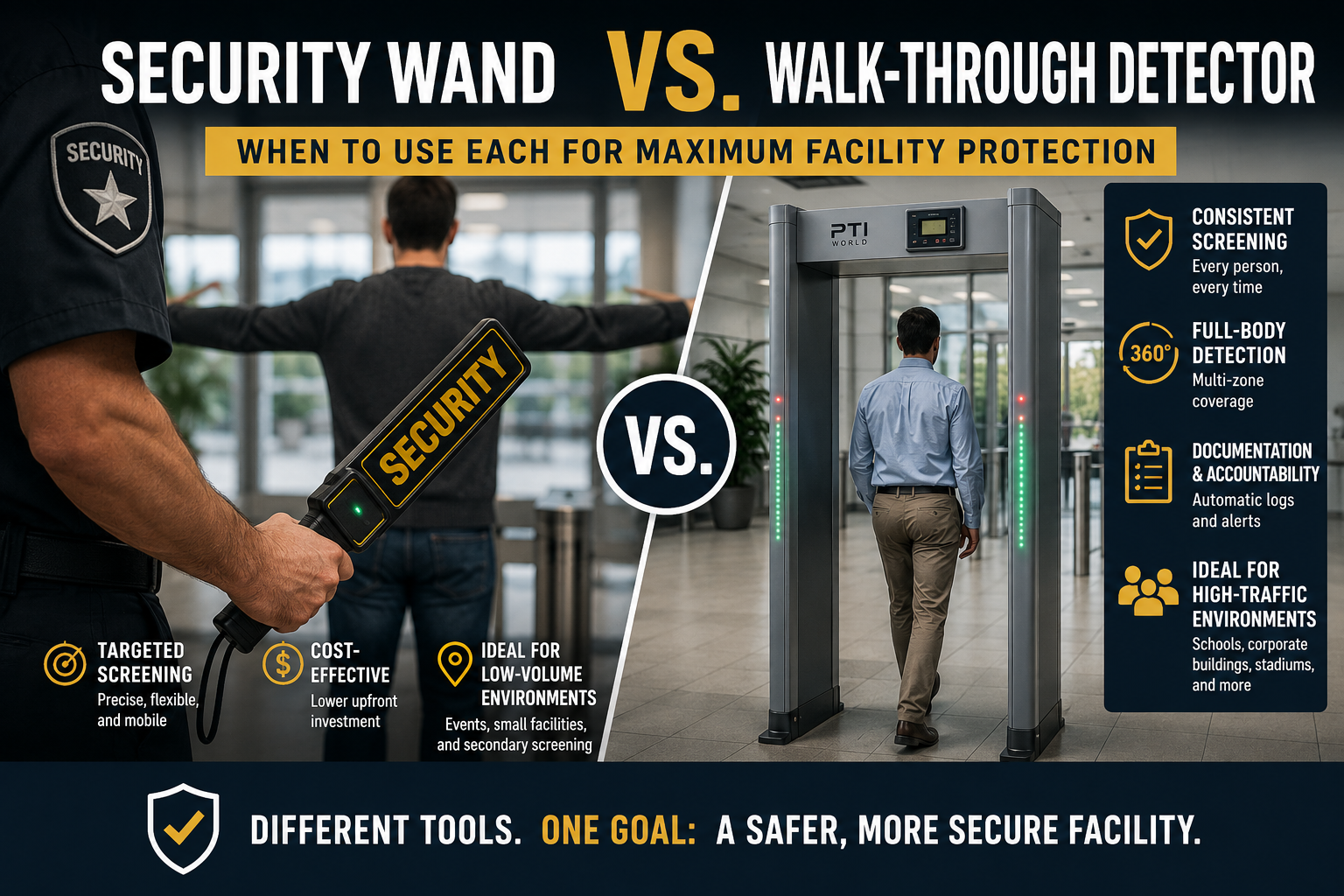
Handheld metal detectors – commonly called security wands – are precise, mobile, and flexible. An operator can direct the wand exactly where suspicion warrants, scanning specific areas of a person’s body, clothing, or carried items without subjecting the entire person to a full portal sweep. They require no infrastructure, no installation, and no fixed footprint. A single wand can be moved between checkpoints, deployed at outdoor events, or used as a secondary verification tool when a portal alarm needs investigation.
Their sensitivity can be significant. Quality security wands from manufacturers focused on the security market can detect quite small metallic objects, particularly when the operator takes time for a thorough sweep. For small-scale access control – a single entry point to an office, a backstage area at a venue, or a VIP entry lane – a wand in the hands of a competent operator can provide meaningful screening.
Where Wands Fall Short
The limitations of handheld wands are largely human factors. A wand only screens as thoroughly and consistently as the operator wielding it. Speed pressure, attention fatigue, interpersonal discomfort, and implicit bias all affect how thoroughly individual people are scanned. In high-traffic environments, thorough wanding of every person quickly becomes impractical, leading to selective scanning that creates predictable gaps.
There is also the issue of documentation. A walk-through detector creates an automatic record of its alerts – timestamps, sensitivity readings, and alarm events – that can be reviewed for investigation or compliance purposes. Manual wanding generates no equivalent record. In environments where accountability documentation matters, this asymmetry is significant.
What Walk-Through Detectors Do Well
Walk-through metal detectors apply the same screening standard to every person who passes through them, regardless of how busy the checkpoint is or how many hours the operator has been working. They detect metal in all zones simultaneously – providing 360-degree coverage around the person’s body – and generate alerts automatically without requiring active operator engagement for each individual.
This consistency is their most important quality. Compliance and accountability depend on uniform application. Environments where selective or inconsistent screening creates legal or operational exposure – precious metal manufacturing, secure evidence rooms, financial trading floors – benefit from the non-negotiable consistency of portal detection. A useful resource for facilities thinking through this decision is PTI World’s overview of walk-through metal detector options and complementary screening technologies.
Practical Scenarios for Each Tool
A small community event with a few hundred attendees and one security officer may be better served by a handheld wand than a portal – flexibility and mobility matter more than throughput at that scale. A sporting venue processing thousands of fans per hour before a game needs portals at every lane to maintain any screening standard at all.
In a corporate campus context, a walk-through detector at the main entrance handles high-volume morning arrivals, while wands kept at the security desk serve secondary uses – screening visitors in private meeting areas, responding to alerts triggered by the portal, or providing coverage at secondary entry points that do not warrant a full portal installation.
Using Both Together
The most rigorous screening protocols use both tools in a defined sequence. A walk-through detector screens everyone; a wand is used by security personnel to investigate portal alerts precisely and document the findings. This pairing eliminates the main weaknesses of each tool in isolation: the portal provides the consistent, non-selective first screen, and the wand provides the targeted precision needed to resolve ambiguous alerts.
The choice between a security wand and a walk-through detector is a question of operational context, not technical superiority. Each tool has a role that the other cannot fully replace. Facilities that understand the strengths and limitations of both are better positioned to build screening protocols that hold up under real-world pressure – and to invest in the right equipment for their specific situation. Explore the full range of detection options at PTI World.